Limitation: REACH3 was not powered to compare ORR for JAKAFI to individual BATs
Image
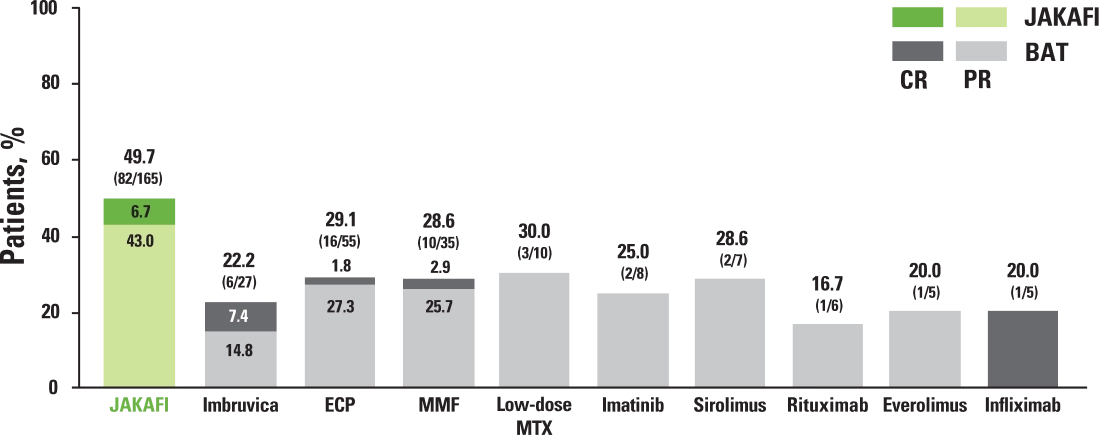
74% of patients on BAT received ECP, MMF, or ibrutinib1†



REACH3 primary endpoint: ORR through week 24
70% (116/165) with JAKAFI vs 57% (94/164) with BAT2
Limitation: REACH3 was not powered to compare ORR for JAKAFI to individual BATs
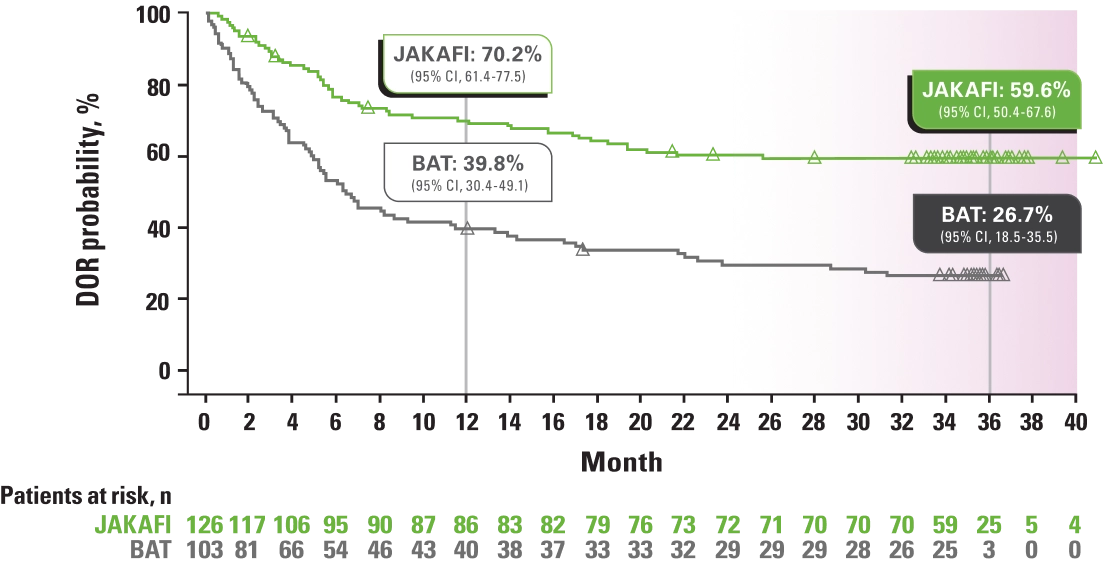
Secondary endpoint: duration of response (DOR)
Patients treated with JAKAFI maintained a response at 12 months and 36 months vs BAT (DOR probability: 70.2% and 59.6%, respectively)1,3,4
If I don’t see a response within 7 days, I initiate a second-line treatment, with JAKAFI being my preferred choice.”
Haris Ali, MD, GVHD Expert

3×
more likely to achieve an overall response at week 24 vs BAT (OR, 2.99)1
3
weeks (range: 2-24) with JAKAFI and 4 weeks (range: 2-25) with BAT2
*DOR was defined as the time from first response until cGVHD progression, death, or the date of change/addition of systemic therapies for cGVHD.3
†BAT was chosen by the investigator at the time of randomization.1
‡The 74% value is based on the number of patients treated with BAT (n=158). ORRs for the remaining BATs were 20% (1/5) for everolimus, 25% (2/8) for imatinib, 20% (1/5) for infliximab, 30% (3/10) for low-dose MTX, 16.7% (1/6) for rituximab, and 28.6% (2/7) for sirolimus.1,5
§REACH3 was not powered to compare ORR for JAKAFI to individual BATs.
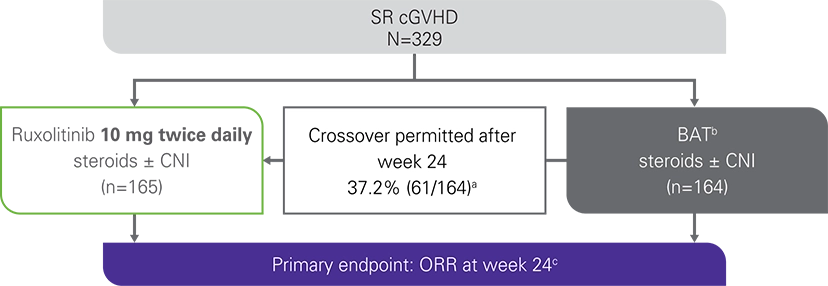
aCrossover from BAT to JAKAFI was permitted on or after week 24 if patients progressed, had a mixed or unchanged response, developed toxicity to BAT, or experienced a cGVHD flare. 61 patients crossed over to JAKAFI after week 24. 72% of those who crossed over remained on JAKAFI longer than 24 weeks.1,3
bBAT was chosen by the investigator prior to randomization: Options included ibrutinib, ECP, low-dose MTX, MMF, rituximab, everolimus, sirolimus, imatinib, infliximab, and pentostatin.2
cDefined as the proportion of patients with CR or PR at week 24.1
*Organ involvement at baseline for all patients (N=329): skin (71.1%), mouth (60.8%), eyes (57.4%), lungs (42.9%), joints and fascia (27.4%), liver (24.9%), GI tract (22.8%), genital tract (9.4%), missing (0.3%). Organ involvement was based on NIH consensus staging criteria at screening. A score of ≥1 was counted as organ involvement. Patients with missing assessments of single organs were counted as having no organ involvement for the organ assessed.1
BAT=best available therapy; BID=twice daily; cGVHD=chronic graft-versus-host disease; CNI=calcineurin inhibitor; CR=complete response; ECP=extracorporeal photopheresis; GI=gastrointestinal; MMF=mycophenolate mofetil; MTX=methotrexate; NIH=National Institutes of Health; ORR=overall response rate; PR=partial response; REACH=Ruxolitinib in patiEnts with refrACtory graft-versus-Host disease after allogeneic stem cell transplantation; SD=steroid dependent; SR=steroid refractory.


Limitations: Post hoc analysis was not powered for statistical significance and results should be interpreted with caution.
No significant differences were observed between ruxolitinib time-to-treatment subgroups for ORR, BOR, or DOR.6
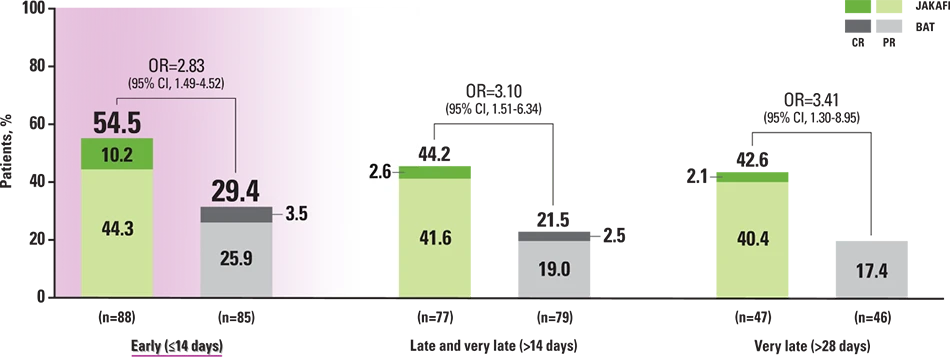
My experience has taught me the importance of early intervention on second-line therapy. This is supported by the REACH3 data."
Haris Ali, MD, GVHD Expert



Limitations: This was a prespecified secondary endpoint that was not powered for statistical significance and is therefore considered exploratory.
Subgroup analyses have an increased risk of false positives due to multiple testing and may have reduced statistical power in smaller subgroups.
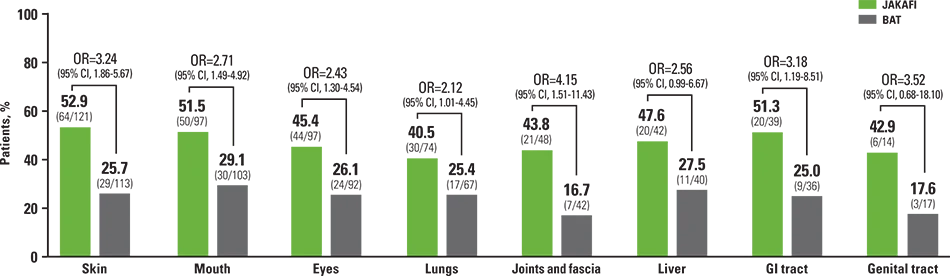
aPatients with >1 affected organ were counted in each organ subgroup. Organ involvement was defined as organ score ≥1 based on the cGVHD staging criteria.1

Seeing that JAKAFI is effective gives us the confidence to initiate JAKAFI at early changes in skin disease to really get the opportunity to help control cGVHD.”
Preet M. Chaudhary, MD, PhD, GVHD Expert
BAT=best available therapy; BOR=best overall response; cGVHD=chronic graft-versus-host disease; CI=confidence interval; CR=complete response; ECP=extracorporeal photopheresis; GI=gastrointestinal; MMF=mycophenolate mofetil; MTX=methotrexate; NIH=National Institutes of Health; OR=odds ratio; ORR=overall response rate; PR=partial response; REACH=Ruxolitinib in patiEnts with refrACtory graft-versus-Host disease after allogeneic stem cell transplantation; SR=steroid refractory.
References: 1. Zeiser R, Polverelli N, Ram R, et al; for the REACH3 Investigators. Ruxolitinib for glucocorticoid-refractory chronic graft‑versus‑host disease. N Engl J Med. 2021;385(3):228-238. Supplementary appendix available at: https://www.nejm.org/doi/full/10.1056/NEJMoa2033122. 2. JAKAFI/JAKAFI XR Prescribing Information. Wilmington, DE: Incyte Corporation. 3. Data on file. Incyte Corporation. Wilmington, DE. 4. Zeiser R, Russo D, Ram R, et al. Ruxolitinib in patients with chronic graft-versus-host disease: 3-year final analysis of efficacy and safety from the phase III REACH3 study. Presented at: 65th American Society of Hematology Annual Meeting and Exposition; December 9-12, 2023; San Diego, CA. Session 722. 5. Locatelli F; for the REACH3 Study Group. Ruxolitinib vs best available therapy in patients with steroid-refractory/dependent chronic graft-vs-host disease: subgroup analyses of overall response rate in the phase 3 REACH3 trial. Presented at: 47th Annual Meeting of the EBMT; March 14-17, 2021; Rome, Italy. 6. Zeiser R, Xue Z, Bhatt V, Galvin J, Locatelli F. Early versus late treatment with ruxolitinib in patients with steroid-refractory chronic graft-versus-host disease: a post hoc analysis from the randomized, phase 3 REACH3 study. Poster presented at: 64th American Society of Hematology (ASH) Annual Meeting and Exposition; December 10-13, 2022; New Orleans, LA.
Thrombocytopenia, Anemia and Neutropenia
JAKAFI®/JAKAFI XR™ (ruxolitinib) is for treatment of intermediate or high‑risk myelofibrosis (MF), including primary MF, post–polycythemia vera MF and post–essential thrombocythemia MF in adults.
JAKAFI/JAKAFI XR is for treatment of polycythemia vera (PV) in adults who have had an inadequate response to or are intolerant of hydroxyurea.
JAKAFI/JAKAFI XR is for treatment of steroid‑refractory acute graft‑versus‑host disease (aGVHD) in adult and pediatric patients 12 years and older.
JAKAFI/JAKAFI XR is for treatment of chronic graft‑versus‑host disease (cGVHD) after failure of one or two lines of systemic therapy in adult and pediatric patients 12 years and older.
Risk of Infection
Tuberculosis
Progressive Multifocal Leukoencephalopathy
Herpes Zoster and Herpes Simplex
Hepatitis B
Symptom Exacerbation Following Interruption or Discontinuation of Treatment
Non‑Melanoma Skin Cancer (NMSC)
Lipid Elevations
Major Adverse Cardiovascular Events (MACE)
Thrombosis
Secondary Malignancies
Adverse Reactions
Drug Interactions
Pregnancy
Please see Full Prescribing Information for JAKAFI/JAKAFI XR.
JAKAFI XR and the JAKAFI XR logo are trademarks of Incyte.
Niktimvo and the Niktimvo logo are trademarks of Incyte.
Incyte and the Incyte logo are registered trademarks of Incyte.
Niktimvo (axatilimab) is licensed to Incyte from Syndax.
All other trademarks are the property of their respective owners.
© 2026, Incyte. INC‑0043 08/26
