


After initial systemic
treatment failure,
INTERVENE EARLY1

To target immune-driven inflammation1
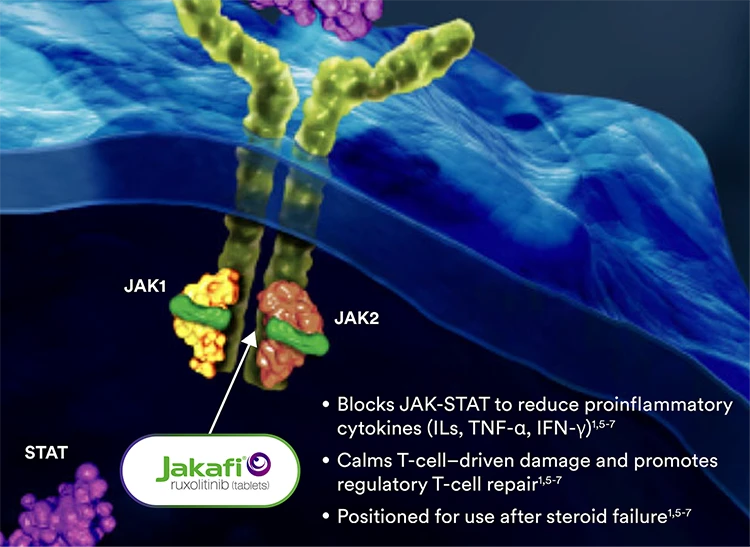
After at least 2 prior lines of systemic therapy,
TARGET SUBOPTIMAL RESPONSES2

To target macrophage-driven inflammation and fibrosis2,4
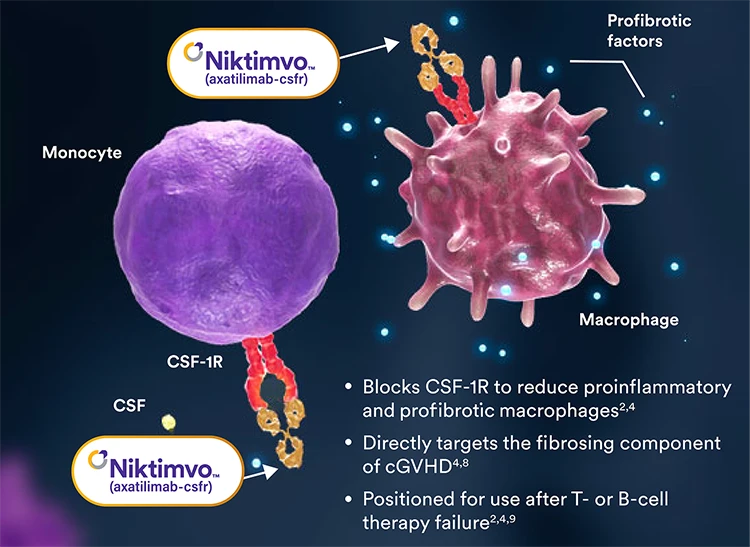
Correlation with clinical effect has not been established.
INDICATIONS AND USAGE
JAKAFI®/JAKAFI XR™ (ruxolitinib) is for treatment of chronic graft-versus-host disease (cGVHD) after failure of one or two lines of systemic therapy in adult and pediatric patients 12 years and older.
SELECT SAFETY INFORMATION
Warnings and Precautions
Thrombocytopenia, Anemia and Neutropenia
JAKAFI/JAKAFI XR can cause dose-related effects of thrombocytopenia, anemia and neutropenia. Perform a pre-treatment complete blood count (CBC) and monitor CBCs every 2 to 4 weeks until doses are stabilized, and then as clinically indicated. Manage thrombocytopenia by reducing the dose or temporarily interrupting JAKAFI/JAKAFI XR. Platelet transfusions may be necessary. Patients developing anemia may require blood transfusions and/or dose modifications of JAKAFI/JAKAFI XR.
Please see Full Important Safety Information and Full Prescribing Information for JAKAFI/JAKAFI XR.
INDICATIONS AND USAGE
Niktimvo™ (axatilimab-csfr) is a colony stimulating factor-1 receptor (CSF-1R)–blocking antibody indicated for the treatment of chronic graft-versus-host disease (cGVHD) after failure of at least two prior lines of systemic therapy in adult and pediatric patients weighing at least 40 kg.
SELECT SAFETY INFORMATION
WARNINGS AND PRECAUTIONS
Infusion-Related Reactions
Niktimvo can cause infusion-related reactions. Infusion-related reactions, including hypersensitivity reactions, occurred in 18% of patients who received Niktimvo in the clinical trial (AGAVE-201), with Grade 3 or 4 reactions in 1.3%.
Please see Full Important Safety Information and Full Prescribing Information for Niktimvo.
cGVHD=chronic graft-versus-host disease; CSF-1R=colony stimulating factor-1 receptor; IFN=interferon; IL=interleukin; JAK=Janus kinase; MOA=mechanism of action; STAT=signal transducer and activator of transcription; TNF=tumor necrosis factor.
References: 1. JAKAFI/JAKAFI XR Prescribing Information. Wilmington, DE: Incyte Corporation. 2. Niktimvo Prescribing Information. Wilmington, DE: lncyte Corporation. 3. Hamilton BK. Updates in chronic graft-versus-host disease. Hematology Am Soc Hematol Educ Program. 2021;2021(1):648-654. 4. Wolff D, Cutler C, Lee SJ, et al; for the AGAVE-201 Investigators. Axatilimab in recurrent or refractory chronic graft-versus-host disease. N Engl J Med. 2024;391(11):1002-1014. Supplementary appendix available at: https://www.nejm.org/doi/full/10.1056/NEJMoa2401537. 5. Zhang M-y, Zhao P, Zhang Y, Wang J-s. Efficacy and safety of ruxolitinib for steroid-refractory graft-versus-host disease: systematic review and meta-analysis of randomised and non-randomised studies. PLoS One. 2022;17(7):e0271979. doi:10.1371/journal.pone.0271979. 6. Ferreira AM, Szor RS, Molla VC, et al. Long-term follow-up of ruxolitinib in the treatment of steroid-refractory chronic graft-versus-host disease. Transplant Cell Ther. 2021;27(9):777.e1-777.e6. doi:10.1016/j.jtct.2021.06.002. 7. Arpaia N, Green JA, Moltedo B, et al. A distinct function of regulatory T cells in tissue protection. Cell. 2015;162(5):1078-1089. 8. Kitko CL, Arora M, DeFilipp Z, et al. Axatilimab for chronic graft-versus-host disease after failure of at least two prior systemic therapies: results of a phase I/II study. J Clin Oncol. 2023;41(10):1864-1875. 9. Zeiser R, Polverelli N, Ram R, et al; for the REACH3 Investigators. Ruxolitinib for glucocorticoid-refractory chronic graft-versus-host disease. N Engl J Med. 2021;385(3):228-238. Supplementary appendix available at: https://www.nejm.org/doi/full/10.1056/NEJMoa2033122.
