For PV in adults who have had an inadequate response to or are intolerant of HU1

Once-daily dosing with JAKAFI XR (ruxolitinib)1

Dose optimization is key to maintaining the balance between safety and efficacy1

1
START
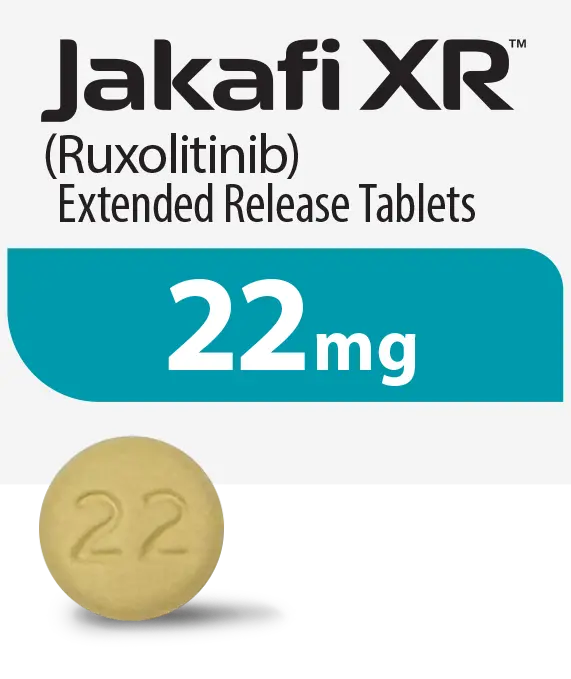
  • For patients with PV who have an inadequate response to or are intolerant of HU, the recommended starting dose of JAKAFI XR is 22 mg once daily
  • A CBC must be performed before initiating JAKAFI XR
  • Before initiating JAKAFI XR, inquire about past infections, including tuberculosis, herpes simplex, herpes zoster, and hepatitis B
  • JAKAFI XR is dosed orally and can be administered with or without food
  • Patients must swallow JAKAFI XR tablets whole. Do not split, chew, or crush tablets
Image
Jakafi XR 22 mg tablet
Image
Jakafi XR 22 mg tablet
 

JAKAFI® (ruxolitinib) and JAKAFI XR doses: 

JAKAFI dosages

  • 5 mg twice daily 

    Image
    Jakafi tablet with 5 imprint
  • 10 mg twice daily 

    Image
    Jakafi tablet with 10 imprint
  • 15 mg twice daily 

    Image
    Jakafi tablet with 15 imprint
  • 20 mg twice daily 

    Image
    Jakafi tablet with 20 imprint
  • 25 mg twice daily 

    Image
    Jakafi tablet with 25 imprint

JAKAFI XR dosages

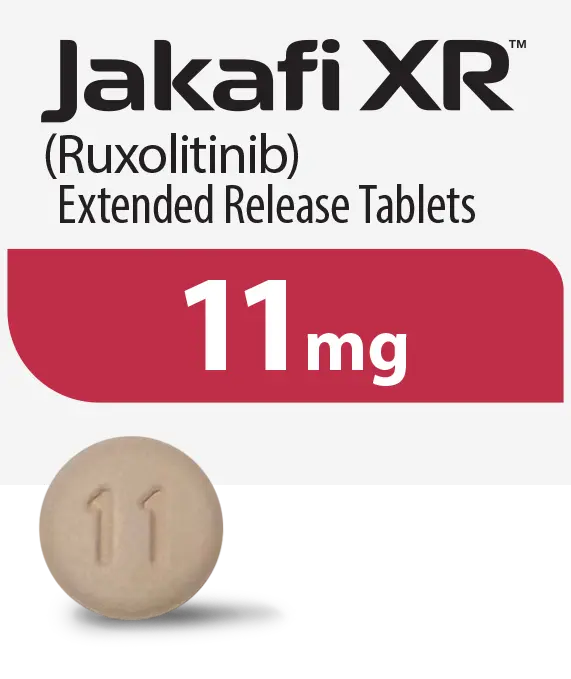
  • 11 mg once daily 

    Image
    Jakafi XR tablet with 11 imprint
  • 22 mg once daily 

    Image
    Jakafi XR tablet with 22 imprint
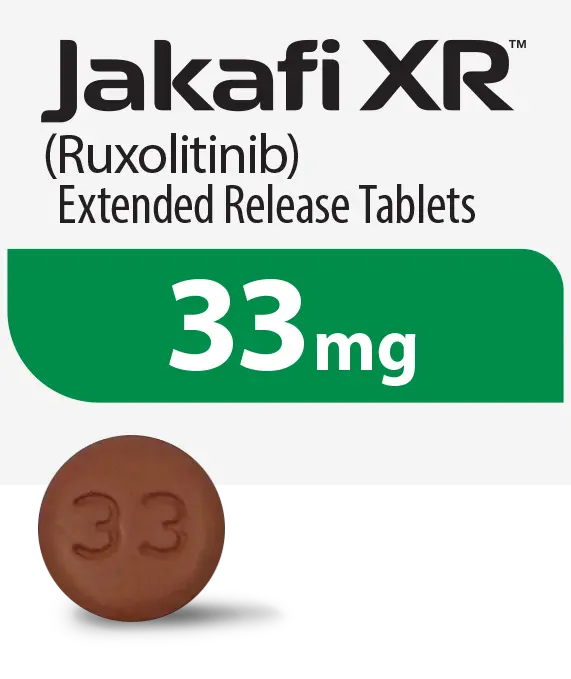
  • 33 mg once daily 

    Image
    Jakafi XR tablet with 33 imprint
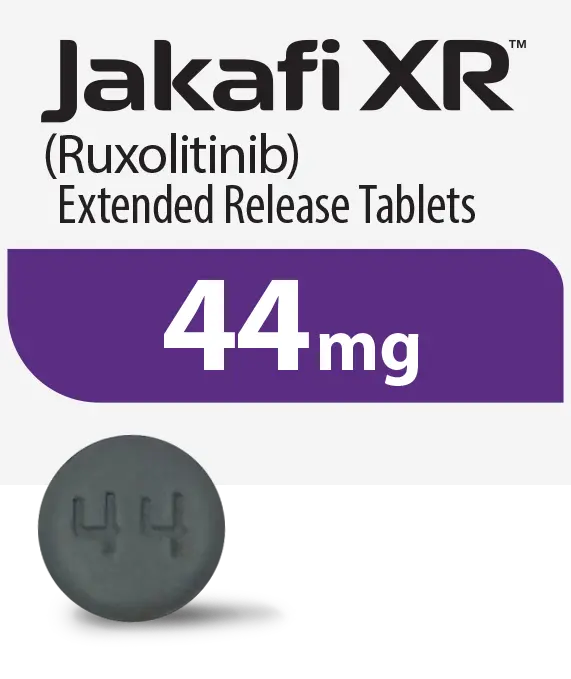
  • 44 mg once daily 

    Image
    Jakafi XR tablet with 44 imprint
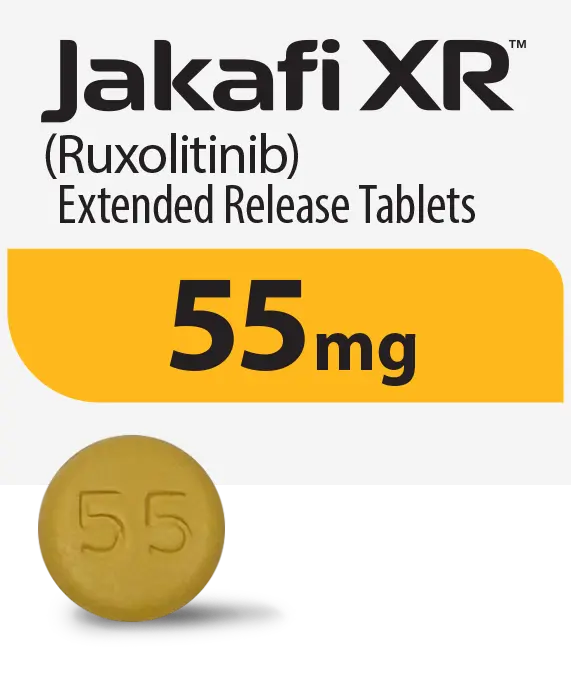
  • 55 mg once daily 

    Image
    Jakafi XR tablet with 55 imprint
  • Image
    Jakafi XR 11 mg tablet
  • Image
    Jakafi XR 33 mg tablet
  • Image
    Jakafi XR 44 mg tablet
  • Image
    Jakafi XR 55 mg tablet

Tablet images shown are for demonstration purposes only and do not represent actual medications.

Dose modifications should be considered based on monitoring complete blood count (CBC), including platelet counts, absolute neutrophil count (ANC), and hemoglobin; treatment interruption and restarting dosing; or other adverse reactions, as described in the Full Prescribing Information for JAKAFI and JAKAFI XR.

 
2
MONITOR

During treatment with JAKAFI XR

  • A CBC must be performed before initiating JAKAFI XR, every 2 to 4 weeks until doses are stabilized, and then as clinically indicated
  • Assess lipid parameters approximately 8 to 12 weeks following initiation of JAKAFI XR

Missed dose

  • If a dose is missed, patients should not take an additional dose but should take the next usual prescribed dose
 
3
OPTIMIZE

Individualize dosing of JAKAFI XR to optimize the balance between safety and efficacy

  • Dosing may be reduced or temporarily interrupted based on hemoglobin, platelet, or neutrophil counts
  • Additionally, dosing may be increased to achieve desired clinical response
  • Interrupt treatment for bleeding

HU=hydroxyurea; PV=polycythemia vera.

The effectiveness and safety of JAKAFI XR have been established based on adequate and well-controlled studies of JAKAFI

JAKAFI XR received approval based on comprehensive data demonstrating bioequivalence to JAKAFI1

Decrease dose for anemia or thrombocytopenia1

Table showing Jakafi XR dosing recommendations based on hemoglobin and platelet count

Hb=hemoglobin.

Increase dose for insufficient response1

If the response is insufficient and platelet, Hb, and neutrophil counts are adequate, JAKAFI XR doses may be increased in increments of 11 mg once daily to a maximum of 55 mg once daily

  • Doses should not be increased during the first 4 weeks of therapy and should not be increased more frequently than every 2 weeks

Consider dose increases in patients who meet all of these criteria:

  • Inadequate efficacy as demonstrated by 1 or more of the following:
    • - Continued need for phlebotomy
    • - WBC count greater than the ULN range
    • - Platelet count greater than the ULN range
    • - Palpable spleen that is reduced <25% from baseline
  • Platelet count ≥140 × 109/L
  • Hb ≥12 g/dL
  • ANC ≥1.5 × 10⁹/L

ANC=absolute neutrophil count; Hb=hemoglobin; ULN=upper limit of normal; WBC=white blood cell.

Interrupting/restarting dosing1

Interrupt JAKAFI XR treatment for:

  • Anemia (Hb <8 g/dL),
  • Thrombocytopenia (platelet count <50 × 109/L), or
  • Neutropenia (ANC <1.0 × 10⁹/L)

After recovery of hematologic parameter(s) to acceptable levels, dosing may be restarted.

Use the most severe category of patients’ Hb, platelet count, or ANC abnormality to determine the corresponding maximum restarting dose:
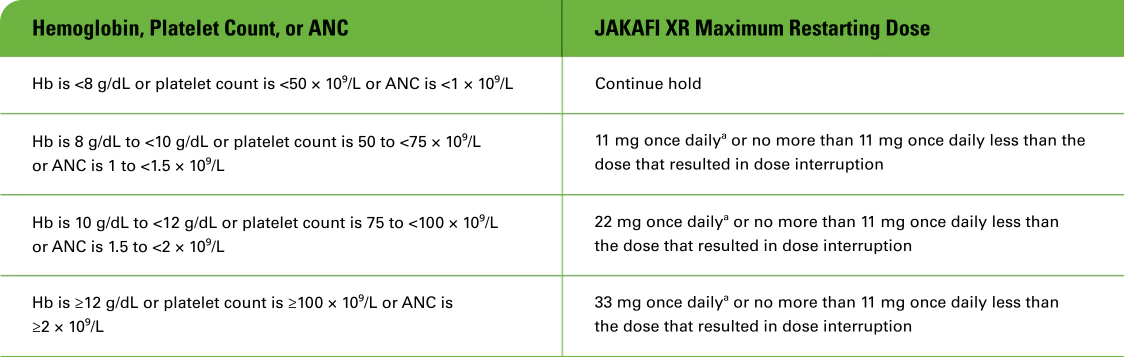
Table showing Jakafi XR maximum restarting dose table based on hemoglobin, platelet count, or ANC
  • aContinue JAKAFI XR treatment for at least 2 weeks; if stable, may increase dose by 11 mg once daily.

Patients who required dose interruption while receiving a dose of JAKAFI XR 11 mg once daily may restart JAKAFI XR at a dose of 11 mg once daily, but not higher, when they have:

  • Hb ≥10 g/dL
  • Platelet count ≥75 × 109/L
  • ANC ≥1.5 × 10⁹/L

Dose management after restarting treatment in PV:

  • After restarting JAKAFI XR following treatment interruption, doses may be titrated, but the maximum total daily dose should not exceed 11 mg once daily less than the dose that resulted in the dose interruption
  • An exception to this is dose interruption following phlebotomy-associated anemia, in which case the maximal total daily dose allowed after restarting JAKAFI XR would not be limited

Special populations:

  • Avoid fluconazole doses >200 mg daily with JAKAFI XR
  • Avoid use of JAKAFI XR in patients with end-stage renal disease (CLcr <15 mL/min) not requiring dialysis

ANC=absolute neutrophil count; CLcr=creatinine clearance; Hb=hemoglobin; PV=polycythemia vera.

Dose modifications for special populations1

Modify the dose of JAKAFI XR accordingly in patients with moderate or severe renal impairment, patients with hepatic impairment, and patients on dialysis.

Table showing recommended starting doses of Jakafi XR for patients with renal or hepatic impairment, based on platelet count

Patients with ESRD on dialysis

  • Do not use JAKAFI XR for patients with PV who have ESRD (CLcr <15 mL/min) and are on dialysis with any platelet count
  • Avoid use of JAKAFI XR in patients with ESRD (CLcr <15 mL/min) not requiring dialysis

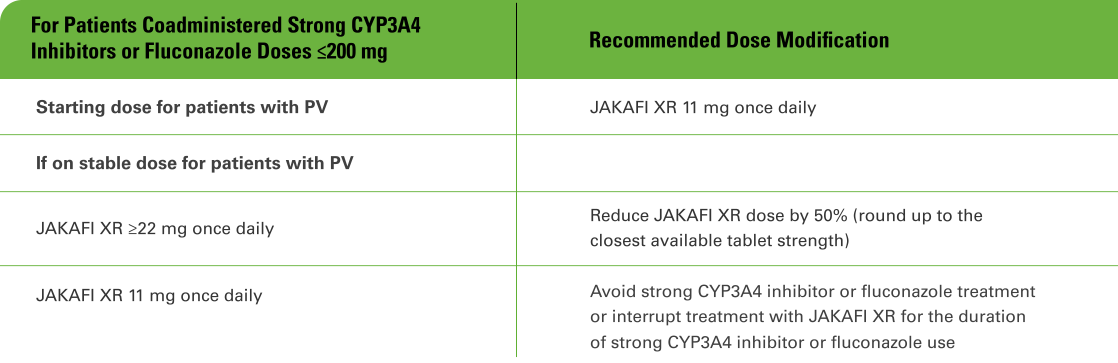
Concomitant use with strong CYP3A4 inhibitors or fluconazole

  • Modify the dose of JAKAFI XR when coadministered with strong CYP3A4 inhibitors and fluconazole doses of ≤200 mg
  • Avoid the use of fluconazole doses >200 mg daily with JAKAFI XR
  • Additional dose modifications should be made with frequent monitoring of safety and efficacy
Image
Table showing recommended Jakafi XR dose modifications for patients with polycythemia vera (PV) receiving strong CYP3A4 inhibitors or fluconazole doses of 200 mg or less

CLcr=creatinine clearance; ESRD=end-stage renal disease; PV=polycythemia vera.

HU=hydroxyurea; MPN=myeloproliferative neoplasm; PV=polycythemia vera.

Reference: 1. JAKAFI/JAKAFI XR Prescribing Information. Wilmington, DE: Incyte Corporation.

+

INDICATIONS AND USAGE

JAKAFI®/JAKAFI XR™ (ruxolitinib) is for treatment of intermediate or high-risk myelofibrosis (MF), including primary MF, post–polycythemia vera MF and post–essential thrombocythemia MF in adults.

JAKAFI/JAKAFI XR is for treatment of polycythemia vera (PV) in adults who have had an inadequate response to or are intolerant of hydroxyurea.

JAKAFI/JAKAFI XR is for treatment of steroid-refractory acute graft-versus-host disease (aGVHD) in adult and pediatric patients 12 years and older.

JAKAFI/JAKAFI XR is for treatment of chronic graft-versus-host disease (cGVHD) after failure of one or two lines of systemic therapy in adult and pediatric patients 12 years and older.

IMPORTANT SAFETY INFORMATION

Warnings and Precautions

Thrombocytopenia, Anemia and Neutropenia

  • JAKAFI/JAKAFI XR can cause dose-related effects of thrombocytopenia, anemia and neutropenia. Perform a pre-treatment complete blood count (CBC) and monitor CBCs every 2 to 4 weeks until doses are stabilized, and then as clinically indicated.
  • Manage thrombocytopenia by reducing the dose or temporarily interrupting JAKAFI/JAKAFI XR. Platelet transfusions may be necessary.
  • Patients developing anemia may require blood transfusions and/or dose modifications of JAKAFI/JAKAFI XR.
  • Severe neutropenia (ANC <0.5 × 10⁹/L) was generally reversible by withholding JAKAFI/JAKAFI XR until recovery.

Risk of Infection

Tuberculosis

  • Serious bacterial, mycobacterial, fungal and viral infections have occurred. Delay starting JAKAFI/JAKAFI XR until active serious infections have resolved. Observe patients receiving JAKAFI/JAKAFI XR for signs and symptoms of infection and manage promptly.
  • Tuberculosis (TB) infection with JAKAFI/JAKAFI XR has been reported. Observe patients taking JAKAFI/JAKAFI XR for signs and symptoms of active TB and manage promptly. Prior to initiating, evaluate patients for TB risk factors and test those at higher risk for latent infection. Consult a physician with expertise in the treatment of TB before starting in patients with evidence of active or latent TB. Continuation during treatment of active TB should be based on the overall risk-benefit determination.

Progressive Multifocal Leukoencephalopathy

  • Progressive multifocal leukoencephalopathy (PML) has occurred with JAKAFI/JAKAFI XR treatment. If PML is suspected, stop JAKAFI/JAKAFI XR and evaluate.

Herpes Zoster and Herpes Simplex

  • Herpes zoster infection, reactivation and/or dissemination has been reported in patients receiving JAKAFI/JAKAFI XR. Advise patients about early signs and symptoms of herpes zoster and seek treatment. Monitor patients for the development of herpes simplex infections. If a patient develops evidence of dissemination of herpes simplex, consider interrupting treatment.

Hepatitis B

  • Increases in hepatitis B viral load with or without associated elevations in alanine aminotransferase and aspartate aminotransferase have been reported in patients with chronic hepatitis B virus (HBV) infections.

Symptom Exacerbation Following Interruption or Discontinuation of Treatment

  • When discontinuing JAK-Inhibitors, including JAKAFI/JAKAFI XR, myeloproliferative neoplasm-related signs and symptoms may flare. After discontinuation, some patients with myelofibrosis have experienced fever, respiratory distress, hypotension, disseminated intravascular coagulation (DIC), or multi-organ failure. If any of these occur after discontinuation or while tapering JAKAFI/JAKAFI XR, evaluate and treat any intercurrent illness and consider restarting or increasing the dose. Instruct patients not to interrupt or discontinue JAKAFI/JAKAFI XR without consulting their physician. When discontinuing or interrupting JAKAFI/JAKAFI XR for reasons other than life-threatening toxicities, consider gradual tapering rather than abrupt discontinuation.

Non-Melanoma Skin Cancer (NMSC)

  • NMSC including basal cell, squamous cell, and Merkel cell carcinoma have occurred. Perform periodic skin examinations.

Lipid Elevations

  • Treatment with JAKAFI/JAKAFI XR has been associated with increases in total cholesterol, low-density lipoprotein cholesterol, and triglycerides. Assess lipid parameters 8-12 weeks after initiation.

Major Adverse Cardiovascular Events (MACE)

  • Another JAK-inhibitor has increased the risk of major adverse cardiovascular events (MACE), including cardiovascular death, myocardial infarction, and stroke (compared to those treated with TNF blockers), in patients with rheumatoid arthritis, a condition for which JAKAFI/JAKAFI XR is not indicated. Consider the benefits and risks for the individual patient prior to initiating or continuing therapy, particularly in patients who are current or past smokers and patients with other cardiovascular risk factors. Patients should be informed about the symptoms of serious cardiovascular events and the steps to take if they occur.

Thrombosis

  • Another JAK-inhibitor has increased the risk of thrombosis, including deep venous thrombosis (DVT), pulmonary embolism (PE), and arterial thrombosis (compared to those treated with TNF blockers), in patients with rheumatoid arthritis, a condition for which JAKAFI/JAKAFI XR is not indicated. In patients with myelofibrosis (MF) and polycythemia vera (PV), the rates of thromboembolic events were similar in JAKAFI/JAKAFI XR and control treated patients. Patients with symptoms of thrombosis should be promptly evaluated and treated appropriately.

Secondary Malignancies

  • Another JAK-inhibitor has increased the risk of lymphoma and other malignancies, excluding NMSC (compared to those treated with TNF blockers), in patients with rheumatoid arthritis, a condition for which JAKAFI/JAKAFI XR is not indicated. Patients who are current or past smokers are at additional increased risk.

Adverse Reactions

  • In myelofibrosis, the most common hematologic adverse reactions (incidence >20%) were thrombocytopenia and anemia. The most common nonhematologic adverse reactions (incidence ≥15%) were bruising, dizziness, headache and diarrhea.
  • In polycythemia vera, the most common hematologic adverse reactions (incidence >20%) were thrombocytopenia and anemia. The most common nonhematologic adverse reactions (incidence ≥15%) were bruising, dizziness, headache and diarrhea.
  • In acute graft-versus-host disease, the most common hematologic adverse reactions (incidence >50%) were anemia, thrombocytopenia and neutropenia. The most common nonhematologic adverse reactions (incidence >50%) were infections (pathogen not specified) and edema.
  • In chronic graft-versus-host disease, the most common hematologic adverse reactions (incidence >35%) were anemia and thrombocytopenia. The most common nonhematologic adverse reactions (incidence ≥20%) were infections (pathogen not specified) and viral infections.

Drug Interactions

  • Avoid concomitant use with fluconazole doses greater than 200 mg. Dose modifications may be required when administering fluconazole doses of 200 mg or less, or with strong CYP3A4 inhibitors, or in patients with renal or hepatic impairment. Patients should be closely monitored and the dose titrated based on safety and efficacy.

Pregnancy

  • Use during pregnancy is not recommended and should only be used if the potential benefit justifies the potential risk to the fetus. Women taking JAKAFI/JAKAFI XR should not breastfeed during treatment and for 2 weeks after the final dose.

Please see Full Prescribing Information for JAKAFI and JAKAFI XR.

INDICATIONS AND USAGE

JAKAFI®/JAKAFI XR™ (ruxolitinib) is for treatment of intermediate or high-risk myelofibrosis (MF), including primary MF, post–polycythemia vera MF and post–essential thrombocythemia MF in adults.

JAKAFI/JAKAFI XR is for treatment of polycythemia vera (PV) in adults who have had an inadequate response to or are intolerant of hydroxyurea.

JAKAFI/JAKAFI XR is for treatment of steroid-refractory acute graft-versus-host disease (aGVHD) in adult and pediatric patients 12 years and older.

JAKAFI/JAKAFI XR is for treatment of chronic graft-versus-host disease (cGVHD) after failure of one or two lines of systemic therapy in adult and pediatric patients 12 years and older.

IMPORTANT SAFETY INFORMATION

Warnings and Precautions

Thrombocytopenia, Anemia and Neutropenia

  • JAKAFI/JAKAFI XR can cause dose-related effects of thrombocytopenia, anemia and neutropenia. Perform a pre-treatment complete blood count (CBC) and monitor CBCs every 2 to 4 weeks until doses are stabilized, and then as clinically indicated.
  • Manage thrombocytopenia by reducing the dose or temporarily interrupting JAKAFI/JAKAFI XR. Platelet transfusions may be necessary.
  • Patients developing anemia may require blood transfusions and/or dose modifications of JAKAFI/JAKAFI XR.
  • Severe neutropenia (ANC <0.5 × 10⁹/L) was generally reversible by withholding JAKAFI/JAKAFI XR until recovery.

Risk of Infection

Tuberculosis

  • Serious bacterial, mycobacterial, fungal and viral infections have occurred. Delay starting JAKAFI/JAKAFI XR until active serious infections have resolved. Observe patients receiving JAKAFI/JAKAFI XR for signs and symptoms of infection and manage promptly.
  • Tuberculosis (TB) infection with JAKAFI/JAKAFI XR has been reported. Observe patients taking JAKAFI/JAKAFI XR for signs and symptoms of active TB and manage promptly. Prior to initiating, evaluate patients for TB risk factors and test those at higher risk for latent infection. Consult a physician with expertise in the treatment of TB before starting in patients with evidence of active or latent TB. Continuation during treatment of active TB should be based on the overall risk-benefit determination.

Progressive Multifocal Leukoencephalopathy

  • Progressive multifocal leukoencephalopathy (PML) has occurred with JAKAFI/JAKAFI XR treatment. If PML is suspected, stop JAKAFI/JAKAFI XR and evaluate.

Herpes Zoster and Herpes Simplex

  • Herpes zoster infection, reactivation and/or dissemination has been reported in patients receiving JAKAFI/JAKAFI XR. Advise patients about early signs and symptoms of herpes zoster and seek treatment. Monitor patients for the development of herpes simplex infections. If a patient develops evidence of dissemination of herpes simplex, consider interrupting treatment.

Hepatitis B

  • Increases in hepatitis B viral load with or without associated elevations in alanine aminotransferase and aspartate aminotransferase have been reported in patients with chronic hepatitis B virus (HBV) infections.

Symptom Exacerbation Following Interruption or Discontinuation of Treatment

  • When discontinuing JAK-Inhibitors, including JAKAFI/JAKAFI XR, myeloproliferative neoplasm-related signs and symptoms may flare. After discontinuation, some patients with myelofibrosis have experienced fever, respiratory distress, hypotension, disseminated intravascular coagulation (DIC), or multi-organ failure. If any of these occur after discontinuation or while tapering JAKAFI/JAKAFI XR, evaluate and treat any intercurrent illness and consider restarting or increasing the dose. Instruct patients not to interrupt or discontinue JAKAFI/JAKAFI XR without consulting their physician. When discontinuing or interrupting JAKAFI/JAKAFI XR for reasons other than life-threatening toxicities, consider gradual tapering rather than abrupt discontinuation.

Non-Melanoma Skin Cancer (NMSC)

  • NMSC including basal cell, squamous cell, and Merkel cell carcinoma have occurred. Perform periodic skin examinations.

Lipid Elevations

  • Treatment with JAKAFI/JAKAFI XR has been associated with increases in total cholesterol, low-density lipoprotein cholesterol, and triglycerides. Assess lipid parameters 8-12 weeks after initiation.

Major Adverse Cardiovascular Events (MACE)

  • Another JAK-inhibitor has increased the risk of major adverse cardiovascular events (MACE), including cardiovascular death, myocardial infarction, and stroke (compared to those treated with TNF blockers), in patients with rheumatoid arthritis, a condition for which JAKAFI/JAKAFI XR is not indicated. Consider the benefits and risks for the individual patient prior to initiating or continuing therapy, particularly in patients who are current or past smokers and patients with other cardiovascular risk factors. Patients should be informed about the symptoms of serious cardiovascular events and the steps to take if they occur.

Thrombosis

  • Another JAK-inhibitor has increased the risk of thrombosis, including deep venous thrombosis (DVT), pulmonary embolism (PE), and arterial thrombosis (compared to those treated with TNF blockers), in patients with rheumatoid arthritis, a condition for which JAKAFI/JAKAFI XR is not indicated. In patients with myelofibrosis (MF) and polycythemia vera (PV), the rates of thromboembolic events were similar in JAKAFI/JAKAFI XR and control treated patients. Patients with symptoms of thrombosis should be promptly evaluated and treated appropriately.

Secondary Malignancies

  • Another JAK-inhibitor has increased the risk of lymphoma and other malignancies, excluding NMSC (compared to those treated with TNF blockers), in patients with rheumatoid arthritis, a condition for which JAKAFI/JAKAFI XR is not indicated. Patients who are current or past smokers are at additional increased risk.

Adverse Reactions

  • In myelofibrosis, the most common hematologic adverse reactions (incidence >20%) were thrombocytopenia and anemia. The most common nonhematologic adverse reactions (incidence ≥15%) were bruising, dizziness, headache and diarrhea.
  • In polycythemia vera, the most common hematologic adverse reactions (incidence >20%) were thrombocytopenia and anemia. The most common nonhematologic adverse reactions (incidence ≥15%) were bruising, dizziness, headache and diarrhea.
  • In acute graft-versus-host disease, the most common hematologic adverse reactions (incidence >50%) were anemia, thrombocytopenia and neutropenia. The most common nonhematologic adverse reactions (incidence >50%) were infections (pathogen not specified) and edema.
  • In chronic graft-versus-host disease, the most common hematologic adverse reactions (incidence >35%) were anemia and thrombocytopenia. The most common nonhematologic adverse reactions (incidence ≥20%) were infections (pathogen not specified) and viral infections.

Drug Interactions

  • Avoid concomitant use with fluconazole doses greater than 200 mg. Dose modifications may be required when administering fluconazole doses of 200 mg or less, or with strong CYP3A4 inhibitors, or in patients with renal or hepatic impairment. Patients should be closely monitored and the dose titrated based on safety and efficacy.

Pregnancy

  • Use during pregnancy is not recommended and should only be used if the potential benefit justifies the potential risk to the fetus. Women taking JAKAFI/JAKAFI XR should not breastfeed during treatment and for 2 weeks after the final dose.

Please see Full Prescribing Information for JAKAFI and JAKAFI XR.