

What Changed WITH ARTHUR

Lab results4
Elevated blood counts
- Hct: 46.3%; WBC: 12 × 109/L
Treatment
- HU titrated to 1.5 g/day, the maximum tolerated dose, 6 months ago3
- Received 2 PBTs recently4
- Hct elevated again at current visit4
For US Healthcare Professionals Only

This profile represents a hypothetical patient.
This profile represents a hypothetical patient.

59-year-old4 widowed microbrewer
Elevated blood counts
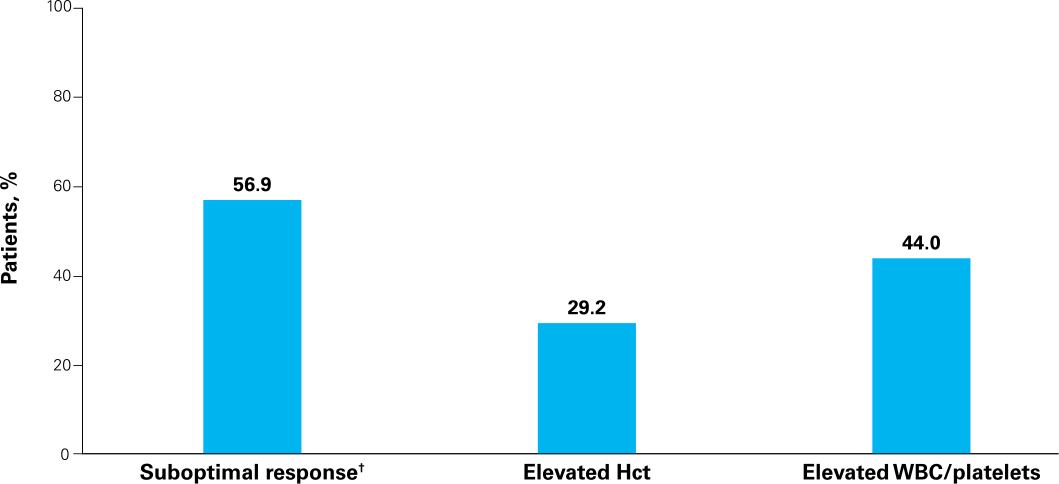
In a retrospective, real-world study of patients with PV who received pharmacologic cytoreductive treatment,*
The majority of patients still had a suboptimal response† to HU at 6 months5
Blood Count Control Among Patients With PV During Pharmacologic Cytoreductive Treatment at 6 Months (n=2015)5
Characteristics, blood counts, treatments, and clinical outcomes of 5871 patients with polycythemia vera treated in US community practices. Lyons RM, Aguilar KM, Sudharshan L, et al. Current Medical Research and Opinion. © 2025 Informa UK Limited. Reprinted by permission of the publisher Informa UK Limited trading as Taylor & Francis Ltd, http://www.tandfonline.com.
*A retrospective observational study of 5871 adult patients with a documented diagnosis of PV in the single-source iKnowMed electronic health record database from US Oncology Network and non-Network clinics. 2257 of these patients received pharmacologic cytoreductive treatment and were evaluable for blood count control.5
†Suboptimal response to HU was defined as meeting ≥1 of the following criteria after ≥3 months of treatment: (1) Hct >45%, (2) WBC count >10 ⨯ 109/L, and/or (3) platelet count >400 ⨯ 109/L.5
CYTO-PV study1‡
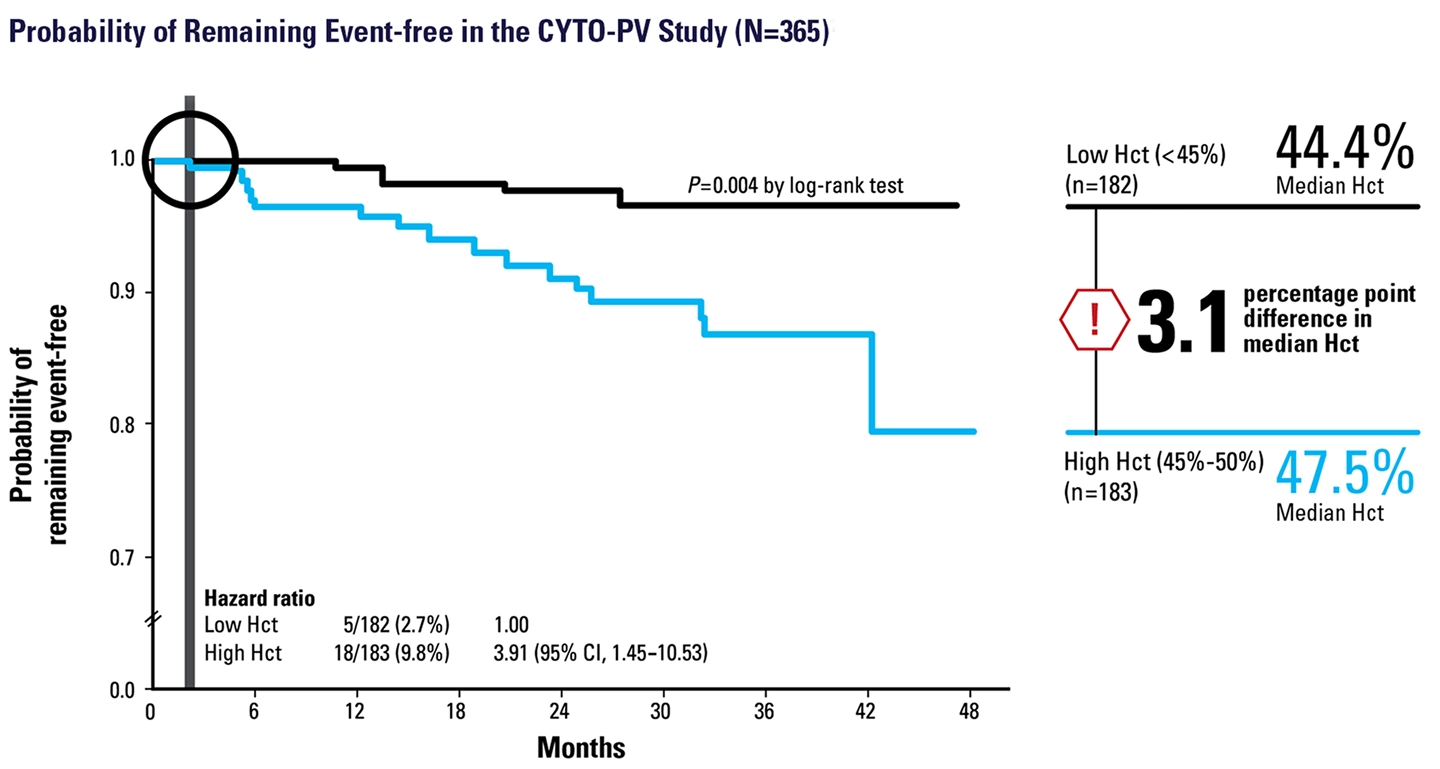
Kaplan-Meier curves for primary composite endpoint.
From The New England Journal of Medicine, Marchioli R, Finazzi G, Specchia G, et al; for the CYTO-PV Collaborative Group, Cardiovascular events and intensity of treatment in polycythemia vera, 368(1):22-33. © 2013 Massachusetts Medical Society. Reprinted with permission from Massachusetts Medical Society.
‡In the CYTO-PV study of 365 adult patients with PV treated with PBT, HU, or both, patients were randomized to 1 of 2 groups: the low-Hct group (n=182; with more intensive therapy to maintain a target Hct level <45%) or the high-Hct group (n=183; with less intensive therapy to maintain a target Hct level of 45% to 50%). Baseline characteristics were balanced between the groups. Approximately 50% of patients had received an initial diagnosis of PV within 2 years prior to randomization. Sixty-seven percent of patients (n=245) were at high risk because they were ≥65 years of age or had experienced previous thrombosis. The composite primary endpoint was the time until CV death or major thrombosis.1
Additional analysis from the CYTO-PV study2
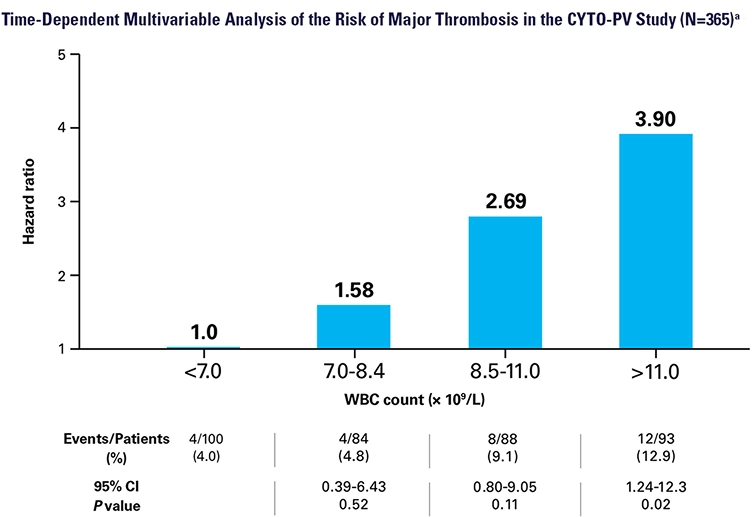
aAdjusted for age, gender, CV risk factors, previous thrombosis, and Hct levels.2
§A retrospective analysis of a real-world study of 1353 patients with PV. Of these patients, 533 who were treated with HU had available data regarding hematologic values, PBT requirements, and HU dose. Hematocrit levels, number of PBTs, and dose of HU were assessed at months 6, 12, 18, 24, 36, 48, and 60 of HU therapy. The requirement of PBT in each patient was calculated as the total number of PBTs divided by time of follow-up and expressed as the number of PBTs per year.3
NCCN Guidelines® recommend
Potential indications for change of cytoreductive therapy for patients with symptomatic low-risk PV, or high-risk PV with inadequate response or loss of response:
||Every 3 to 6 months or more frequently as clinically indicated.8
CI=confidence interval; CV=cardiovascular; CYTO-PV=Cytoreductive Therapy in Polycythemia Vera; Hct=hematocrit; HR=hazard ratio; HU=hydroxyurea; NCCN=National Comprehensive Cancer Network® (NCCN®); PBT=phlebotomy; PV=polycythemia vera; TFS=thrombosis-free survival; WBC=white blood cell.
References: 1. Marchioli R, Finazzi G, Specchia G, et al; for CYTO-PV Collaborative Group. Cardiovascular events and intensity of treatment in polycythemia vera. N Engl J Med. 2013;368(1):22-23. 2. Barbui T, Masciulli A, Marfisi MR, et al. White blood cell counts and thrombosis in polycythemia vera: a subanalysis of the CYTO-PV study. Blood. 2015;126(4):560-561. 3. Alvarez-Larrán A, Pérez-Encinas M, Ferrer-Marín F, et al. Risk of thrombosis according to need of phlebotomies in patients with polycythemia vera treated with hydroxyurea. Haematologica. 2017;102(1):103-109. 4. Vannucchi AM, Kiladjian JJ, Griesshammer M, et al. Ruxolitinib versus standard therapy for the treatment of polycythemia vera. N Engl J Med. 2015;372(5):426-435. Supplementary appendix available at: https://www.nejm.org/doi/suppl/10.1056/NEJMoa1409002/suppl_file/nejmoa1409002_appendix.pdf. 5. Lyons RM, Aguilar KM, Sudharshan L, et al. Characteristics, blood counts, treatments, and clinical outcomes of 5871 patients with polycythemia vera treated in US community practices. Curr Med Res Opin. 2025;41(1):43-51. 6. Gangat N, Strand J, Li C-Y, Wu W, Pardanani A, Tefferi A. Leucocytosis in polycythemia vera predicts both inferior survival and leukaemic transformation. Br J Haematol. 2007;138(3):354-358. 7. Grunwald MR, Kuter DJ, Altomare I, et al. Treatment patterns and blood counts in patients with polycythemia vera treated with hydroxyurea in the United States: an analysis from the REVEAL study. Clin Lymphoma Myeloma Leuk. 2020;20(4):219-225. 8. Referenced with permission from the NCCN Clinical Practice Guidelines in Oncology (NCCN Guidelines®) for Myeloproliferative Neoplasms V.3.2026. © National Comprehensive Cancer Network, Inc. 2026. All rights reserved. Accessed September 20, 2026. To view the most recent and complete version of the guideline, go online to NCCN.org. NCCN makes no warranties of any kind whatsoever regarding their content, use or application and disclaims any responsibility for their application or use in any way.
JAKAFI®/JAKAFI XR™ (ruxolitinib) is for treatment of intermediate or high‑risk myelofibrosis (MF), including primary MF, post–polycythemia vera MF and post–essential thrombocythemia MF in adults.
JAKAFI/JAKAFI XR is for treatment of polycythemia vera (PV) in adults who have had an inadequate response to or are intolerant of hydroxyurea.
JAKAFI/JAKAFI XR is for treatment of steroid‑refractory acute graft‑versus‑host disease (aGVHD) in adult and pediatric patients 12 years and older.
JAKAFI/JAKAFI XR is for treatment of chronic graft‑versus‑host disease (cGVHD) after failure of one or two lines of systemic therapy in adult and pediatric patients 12 years and older.
Please see Full Prescribing Information for JAKAFI/JAKAFI XR.
